Showing posts with label retirement. Show all posts

Wednesday, May 17, 2023

The Book of Mormon


After leaving Bryce Canyon, we had a four-hour drive to our next destination: Salt Lake City KOA Holiday.  Adding to our travel time, we had to stop to fill up our propane and gasoline tanks; we also stopped for lunch.  The drive was beautiful, as we passed through various mountain ranges on our way to our next destination, including the Salt Creek Peak (the highest peak in the San Pitch Mountain range); Mt. Nebo (the southernmost and highest mountain in the Wasatch Range); and Provo Peak.

We arrived at the KOA by late afternoon and set up.  Our site was asphalt, but a bit unlevel, so we had to use a leveling block under the front, driver’s side wheel (Pat had purchased this leveling block at the RV Show in Tampa).  Our RV site had a picnic table, but no grill or fire pit.
After setting up, we did some laundry and Tim ordered Chinese (Wonton Soup and Cashew Chicken) on Uber Eats from a restaurant called New Golden Dragon, which Tim thought was decent but not as good as New York City Chinese food.

We were finally in warmer weather in Salt Lake City, which allowed us to wear shorts again.  The RV sites at KOA were covered by trees that shed catkins (we aren’t totally sure what type of tree it was).  In addition to being messy, the catkin's pollen wreaked havoc with our allergies.

The day after we arrived in Salt Lake City, we took the TRAX (Salt Lake City light rail) downtown to see the Church of Jesus Christ of Latter-Day Saints complex, Temple Square.  There was a TRAX stop almost directly in front of the KOA campground, and the day pass cost $5 each.  We waited about 15 minutes for the train and the ride downtown took approximately 23 minutes on the Green Line.  
We exited the train at the Temple Square Station and walked approximately 6 minutes to the Mormon Tabernacle, which didn’t look as big or as beautiful inside as it does on television (in our opinion).  We couldn’t see the Temple because it was undergoing refurbishing and was completely covered in scaffolding, so that was a bit disappointing; however, we were able to visit the Church History Museum, which had a written history (and film) describing Joseph Smith’s supposed visions and his founding of the Mormon church.  After leaving the Museum, we walked about 12 minutes (uphill) to a memorial park with the graves of Brigham Young, three of his 55 wives (Lucy Ann Decker, Emmeline Free, and Eliza Snow) and two of his 56 children (Joseph and Alice).

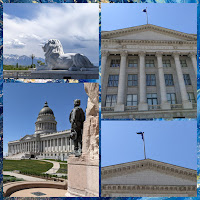
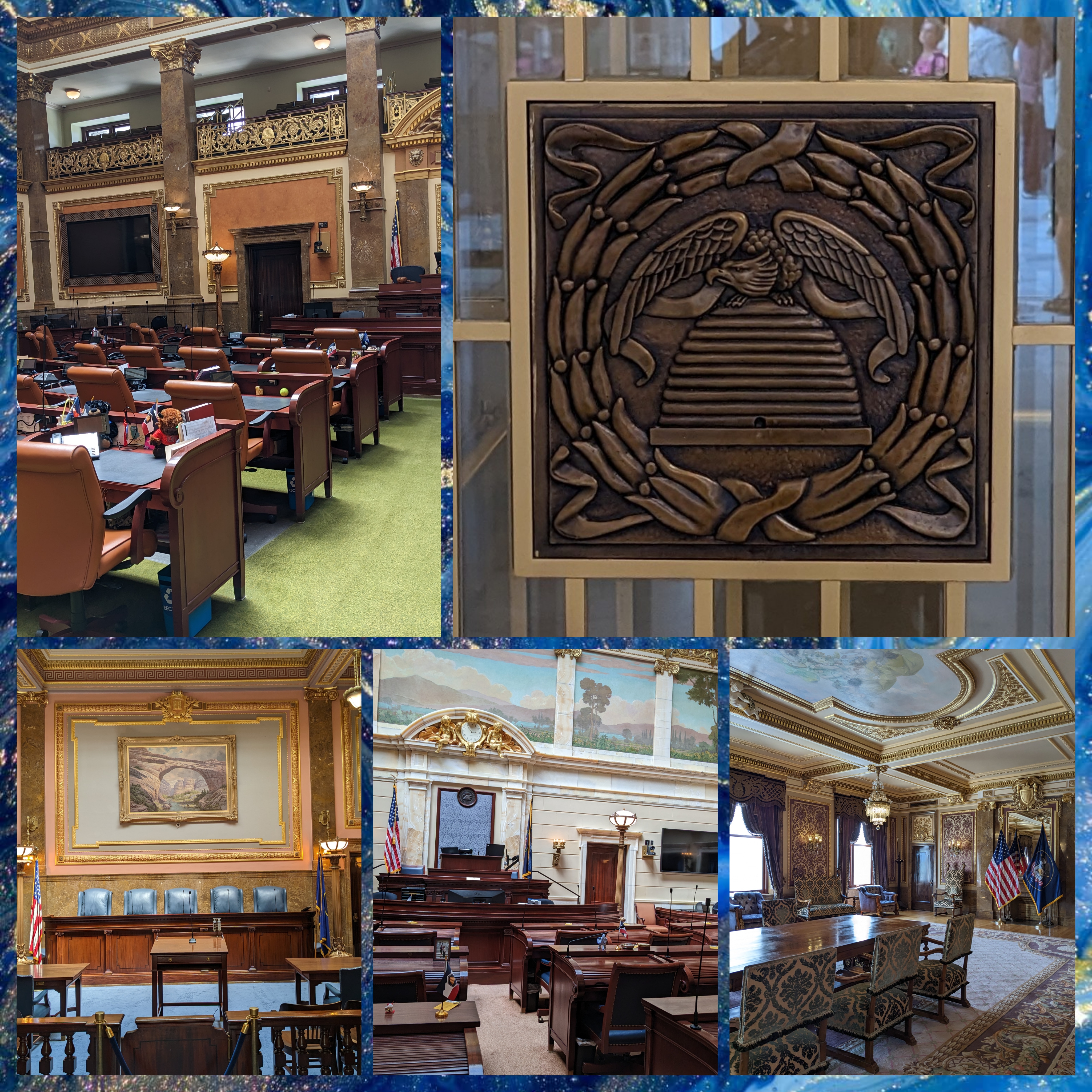
Next, we took a bus to the Utah State Capitol Building.  One of the things we wanted to do during our full-time RV traveling was to visit state capitol buildings.  Although we have visited many state capitol buildings together and separately, this was the first one we have visited since we started full-time RV travel.  The bus trip was free as our $5 daily pass also covered buses.  The bus trip up the hill to the Utah State Capitol Building took approximately 15 minutes and we exited the bus at the Visitor’s Entrance to the capitol.  Once inside, we were allowed to walk freely through the building.  We visited an exhibit on the Capitol Building and viewed the chambers of the House of Representatives, the Senate, and the Supreme Court.  Afterward, we wandered the grounds outside of the Capitol Building, then took a bus to the TRAX station and rode the TRAX train back to the KOA Campground. 

Pat had picked up a rental car earlier in the day for errands and airport transportation (where are the Bla-Mos flying??) while we were in Salt Lake City.  So, when we returned to the KOA Campground from downtown Salt Lake City, Pat drove Tim to the salon at which he had made a haircut appointment: The Salt Lake Barber Company Westside.  Tim enjoyed chatting with his barber, whose name was Drew, and thought Drew did a decent job with his haircut.  After Tim’s haircut, Tim dropped Pat off at Sports Clips so Pat could get a haircut (Pat thinks he doesn’t need a fancy barber for his hair), and Tim drove to Walmart for some grocery shopping.  When we arrived home, we packed for our trip to Puerto Vallarta, Mexico, to celebrate Tim’s 60th birthday!  

The next morning, we drove the RV to Echo State Park in Coalville, Utah, where we would be leaving the RV plugged into electrical while we were in Puerto Vallarta.  We weren’t at Echo State Park very long, but we had a lasting memory from the swarms of giant flies that were in the park, many of which found their way into the RV (and when we returned after our trip to Puerto Vallarta, we found dozens of dead giant flies IN the RV).
After getting the RV plugged into electrical, we drove back to Salt Lake City in the rental car, which we dropped off near the airport.  We stayed overnight in a hotel near the airport with a shuttle because our flight to Puerto Vallarta was leaving at 8:00 a.m. the next morning.  

We will not write about our trip to Puerto Vallarta in the blog since the blog is reserved for our RV travels.  To see pictures from our fantastic stay in Puerto Vallarta for Tim’s 60th birthday, please visit our Facebook pages.


The Salt Lake City KOA Holiday has approximately 214 RV sites, with full hookups, that accommodate different size RVs and campers.  The KOA also has tent sites and cabins.  All RV sites have a picnic table and fire pit (no grills); some come with a separate patio.

Other amenities at the Salt Lake City KOA include a general store with grocery basics and RV supplies; pool; hot tub; and very nice laundry/restroom facilities.  Additionally, the KOA offers an arcade and a playground for the kids; basketball court; and media center.  Campers can also buy propane at the campground.  Uniquely, this KOA has a car/RV wash.  There is also a small restaurant called “Nico’s Mexican American CafĂ©” located nearby.

One of the great things about the Salt Lake City KOA is that the city’s light rail system (Trax) has a stop conveniently located a block from the KOA and the campground is located approximately 14 blocks from downtown.  This makes it convenient and easy to get around town.

Despite our allergy issues from the catkins, we really loved the amenities and the convenience of the Trax station located nearby.  We would definitely consider staying at the Salt Lake City KOA Holiday if we were ever in the area again, although we have probably seen all that we want to see in Salt Lake City.


Review of Echo State Park in Coalville, Utah
We did not stay overnight in our RV at Echo State Park in Coalville, Utah, so we cannot provide a review about our stay; however, we can provide some basic information about the campground.  Echo State Park is located about 48 miles east of Salt Lake City, off of I-80.  The campground has approximately 18 sites for RVs or tents, with electrical and water hookups only (no sewer).  The website indicates that there are 6 RV sites with full hookups located at the Red Rock Marina Campground; we were at the Dry Hollow Campground.

The RV sites are large enough to also accommodate a car and are cement with a covered picnic area that includes a fire pit (no grill).  The campground also has 5 cabins (they call them cottages) for rent.  The campground is located adjacent to the lake (Echo Reservoir) at which you can swim, boat (ramps available), or fish.  The campground also has bathroom/shower facilities and a large picnic area.  Additionally, there is an area available for bike riding or hiking.

The campground was apparently very popular on the weekends, although there weren’t many other campers around when we were there to drop off and pick up the RV on weekdays.  The campground was rather isolated; so, it is great if you want to take advantage of the swimming, boating, or fishing at the campground but not so great for other activities unless you have a car to travel.  We likely would not stay at Echo State Park again due to the limited amenities (even if we had a car) AND THE FLIES.


Monday, May 15, 2023

Bryce Canyon National Park


After the Zion-Mount Carmel Tunnel and then heading up U.S. Highway 89 for forty-three miles, we turned east on Utah State Highway 12 and found ourselves in beautiful Red Canyon of the Dixie National Forest.
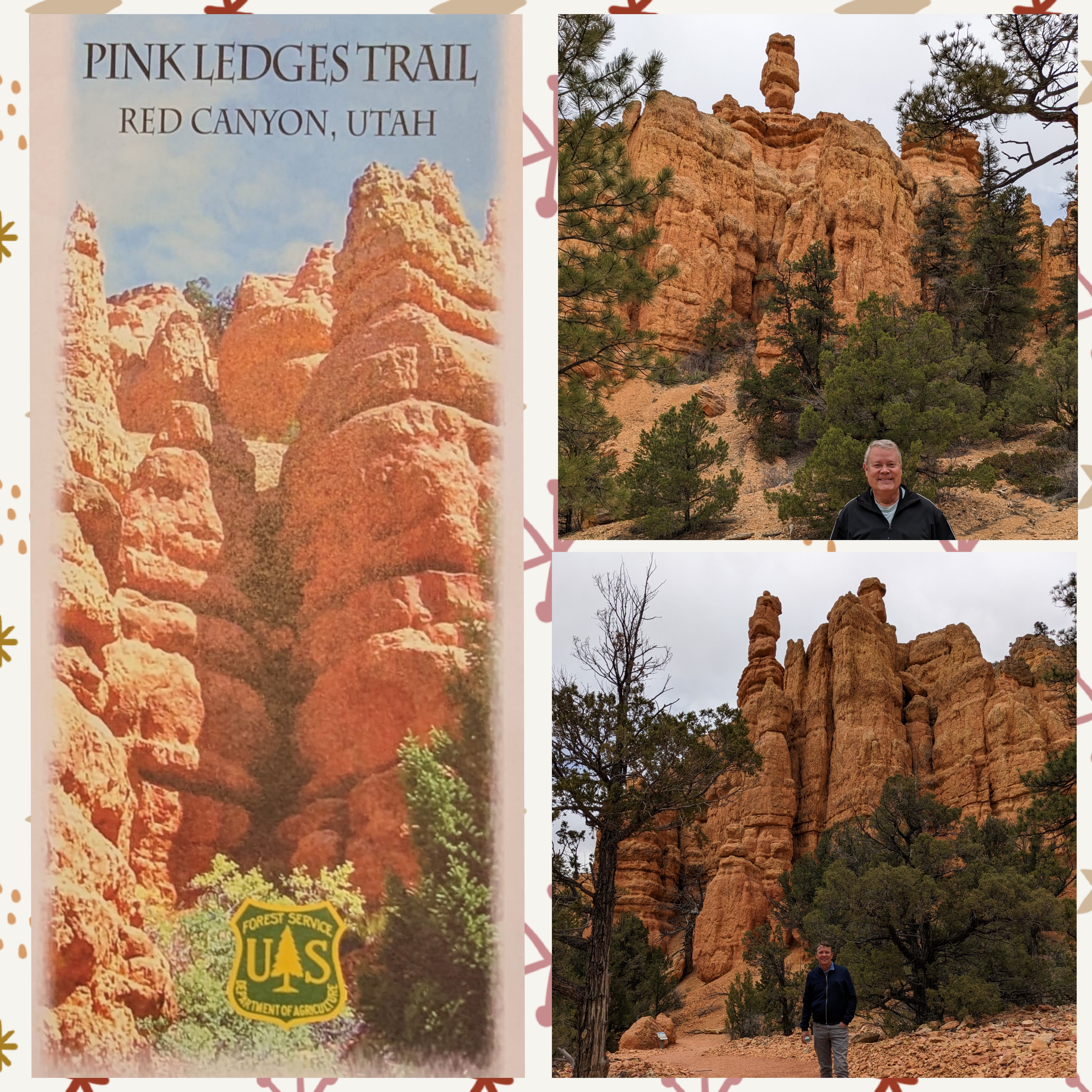
We stopped at the Red Canyon Visitor’s Center, where we ate lunch and bought some souvenirs.  Then we hiked the Pink Ledges Trail in a loop to and from the Visitor’s Center.  This .5-mile trail was easy to moderate and took about 45 minutes.  On the trail, we got a close look at the orange-red limestone and sandstone pinnacles, spires, columns, and hoodoos that make Red Canyon unique (a hoodoo is a rock formation that is shaped from expanding ice seeping into cracks of the rocks and creating structures that sometimes look like a person, animal, or other object; the name is derived from Hoodoo spirituality, in which certain natural forms are said to possess supernatural powers). 
On the drive out of Red Canyon, we drove through two amazing red-rock arch tunnels.  

By late afternoon, we finally arrived at our destination: Ruby’s Inn RV Park and Campground in Bryce Canyon City, Utah.  At an elevation of 7,664 feet, we could feel right away that strenuous activity was going to make it a little harder to breathe.  In addition to being at such a high elevation, we were back to freezing weather.  In fact, the temperature dropped below freezing on our first two nights in Bryce Canyon City (the lows warmed up to the upper 30s for the remainder of our stay, with highs in the 60s).  
Our RV site was dirt/gravel, had full hookups, and was a pull-through site.  The site itself was not wider than normal but was longer than normal; long enough to fit two cars into!  Our RV site did not have a grill, but it had a picnic table and a fire pit (in an odd location on the border with the neighboring RV site).  We were shaded by gigantic pine trees.  We had been advised when we checked into the campground that freezing temperatures were expected that night and that we shouldn’t hook up our hose to city water overnight.  So, we used our freshwater tank for water.  We did this for our first three nights at the campground to remain on the safe side.   

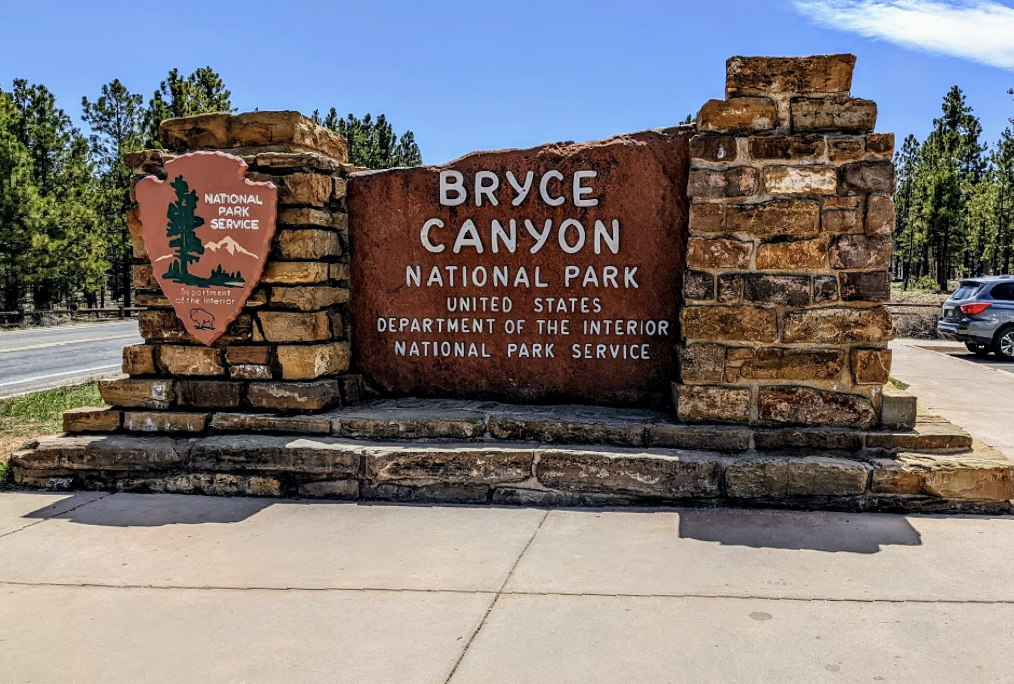
On our first full day at Bryce Canyon, we visited our sixth national park since we started full-time RV travel: Bryce Canyon National Park.  The park features red rocks, pink cliffs, and the largest concentration of hoodoos found anywhere on earth.  Founded in 1923, Bryce Canyon National Park was celebrating its 100th anniversary during our visit.  It is a high-altitude park ranging from 8,000 to 9,000 feet in elevation, and the website warns that even mild exertion can lead to altitude sickness.

Similar to Zion National Park, there was a free shuttle bus that picked us up in Bryce Canyon City and took us to the Visitor’s Center at Bryce Canyon National Park.  There was a shuttle bus stop conveniently located at the entrance to Ruby’s Inn RV Park and Campground.  This time, we didn’t have to exit the shuttle bus at the Visitor’s Center; instead, we could keep riding the same bus in a loop around the park, with stops at various places with trail heads and observation decks (riders must pay the entrance fee to the national park prior to boarding the shuttle bus or show a national park pass, which is what we have).  We chose to exit the shuttle bus at the Visitor’s Center on this first trip, so we could get our passbooks stamped and buy some souvenirs.  

Afterward, we got back on the shuttle bus and took it two stops to Bryce Point (elevation 8,300 feet).  Bryce Point gave us beautiful views of Bryce Canyon; in particular, what are called the Bryce Amphitheaters.  From there, we decided to hike a portion of the Rim Trail, which runs approximately 5.5 miles and follows the Bryce Amphitheater portion of the park with a spectacular view of the park’s most popular area. 
We walked less than .5 miles of the trail and returned to catch the shuttle bus to Inspiration Point.

Inspiration Point (elevation 8,100 feet) provides a bird’s-eye view of the world’s largest collection of hoodoos found within the Bryce Amphitheaters. 
We could have hiked the Rim Trail to Inspiration Point from Bryce Point but chose to save our longest hike of the day for our next stop: Sunset Point.

Nowhere are the colors of Bryce Canyon's rock better displayed than from Sunset Point (elevation 8,000 feet).  The unique rock you can see at Sunset Point is primarily composed of limestone deposited approximately 50 million years ago in a large freshwater lake.  Iron oxide minerals supply the vibrant red, oranges, and yellows of the lower half of the cliffs.

From Sunset Point, we hiked about .5 miles along the Rim trail to Sunrise Point (elevation 8,015 feet).
From Sunrise Point, we caught the shuttle bus back to town and got off of the bus at Ruby’s Inn General Store, where we bought a few grocery items.  From Ruby’s Inn, we took Ruby’s internal shuttle van back to the campground, where the van dropped us off close to our RV site.

Our second full day at Bryce Canyon became another maintenance day.  The past two days we had been running the furnace more than usual because of the freezing temperatures.  
[There is no short way to describe this, we tried.]
About two months ago, when we were in other freezing weather, we found that the furnace sometimes did not ignite the propone to provide warm air after the thermostat triggered that it should.  This happened several times during our first two nights at Bryce Canyon, causing us to have to get up out of bed to lower the thermostat so the fans would go off; then wait a few minutes before raising the thermostat back up to a higher temperature to try to get the furnace to ignite the propane.  Usually, this got the furnace running again, but if we weren’t vigilant, the temperature could drop to the low 60s in the RV before the cold air woke us up and we realized that the fans were running but the propane had not been ignited and the blower was not operating.  So, we spent most of the day watching YouTube videos and trying to figure out what might be the issue.  We came to believe that the problem was with the “sail switch” as many of these videos explained that sometimes lint and other things get caught under the  “sail switch” and won’t allow it to move to indicate that there is sufficient air flow for the blower before igniting the propane.  If the  “sail switch” doesn’t send the okay signal, it triggers the blower to shut off without the furnace igniting the propane.  
[Really, this IS the condensed version.  Ask Tim if you want to know more (everything) about RV furnaces.]
Based on what we watched, we believed that we could resolve the issue on our own by opening the external cover to the furnace and using a can of compressed air to clear any lint or other debris away from the  “sail switch”.  The only problem was that we couldn’t get the external cover off of the furnace.  We thought we might damage the cover if we pulled too hard, so we contacted Stephen, the technician who had fixed our bathroom door while we were at Zion.  Stephen assured us that we were doing the right thing and needed to keep at it.  Finally, we got the external cover off of the furnace (after discovering that someone had previously silicone glued the exhaust cover to the external cover on the RV).
We used the compressed air to clear the  “sail switch” and screwed the external cover back onto the furnace.  Wow, we have certainly become handy!    

But the furnace was not our only maintenance issue on this second full day at Bryce Canyon.  As we tried to finally hook up our shorter freshwater hose to city water (the temperature was supposed to stay above freezing on this night), we discovered that we had a leak in the hose connection.  We then tried to use our longer hose but couldn’t get it to connect properly to the RV without the use of an elbow that was on the shorter hose that had the leak, which we couldn’t get off of the shorter hose.  By this time, it was evening and we decided to go to dinner instead and stay with the freshwater tank for water for another evening.  

We took the internal Ruby’s shuttle van to one of three restaurants located at Ruby’s Inn called Cowboy’s Buffet and Steak Room.  This restaurant offers a buffet but also has a full-service menu if you prefer, which we did!  We shared an appetizer of “cow chips” (potato slices smothered with melted cheese and topped with bacon bits); then Tim had the 8 oz tenderloin filet (with a baked potato and asparagus), while Pat had the Country Fried Steak (with mashed potatoes and asparagus).  I guess we really love potatoes!  The restaurant was quaint and included old photographs on the wall depicting the history of Ruby’s Inn.  After dinner, we went to Ruby’s Inn General Store to buy a new elbow for the longer freshwater hose so we could connect city water to the RV.  We decided to walk back to the campground from Ruby’s Inn (about a half-mile walk), since we hadn’t done much walking yet on that day.  

On our third full day at Bryce Canyon, we had planned to take the shuttle bus to the national park for a longer hike, but the weather had other ideas for us.  It was cloudy and rainy most of the day, and the temperatures stubbornly stayed in the 50s.  Instead, Pat did some laundry and Tim caught up on paying bills, making lists, ancestry research, and writing blog entries.  In the late afternoon, we installed the elbow on the longer hose and connected the hose to city water.  No leaks!  That evening, we had severe thunderstorms that knocked out the power for several hours.  Since it was evening, we weren’t supposed to run our generator (although others did), so we had to rely on our house batteries keeping the furnace working to keep the RV warm while we slept.  We lowered the temperature setting a bit, and the house batteries kept the furnace running until power was restored.

On our last full day at Bryce Canyon, we had a small window of time to take the hike we wanted to take the previous day before rain was forecasted to start again.  We took the free shuttle to the national park and got off at Sunset Point.  From there, we hiked .6 miles downward on the Navajo Loop Trail, then 1.7 miles across and back up to Sunrise Point on the Queen’s Garden Trail.  We started the hike at Sunset Point (elevation 8,000 feet), downward to an elevation of 7,362 feet, and then up again to Sunrise Point (elevation 8,015 feet).  That’s an elevation change of 638 feet down and 653 feet up!  The trail was dirt and wound around the canyon wall with sometimes not very wide paths.  We stopped about halfway through the hike to eat the sandwiches we brought with us and had to take several more breaks on the way back up because of the altitude, but the hike was worth it!  This is the most popular hike in Bryce Canyon National Park because you get to hike down into the canyon to see the hoodoos and the Bryce Amphitheaters from the viewpoint at the bottom of the canyon and then from the viewpoint at the top of the canyon.  The views are spectacular.  We took many pictures that captured the beauty we observed on this hike, but we could never capture the experience in pictures!   


Following our hike, we returned to Ruby’s Inn RV Park and Campground  just before the rain arrived.  We spent the evening inside the RV, catching up on blog entries before going to bed to rest for our travels the next day.
  

In 1916, Reuben (Ruby) Syrett and his wife Clara (Minnie) built a ranch on the site of what is now Ruby’s Inn in Bryce Canyon City, Utah; near what is now Bryce Canyon National Park.  Since 1916, Ruby’s Inn has expanded to accommodate RVs and named the area Ruby’s Inn RV Park and Campground .  

The campground has 250 sites for RVs and tent campers under gigantic pine trees; some RV sites have full hookups and others have just water and electricity.  RV sites are large pull-through sites with plenty of space to spread out in your site.  The RV sites include a picnic table and fire pit, but no grills.  The campground also has log cabins (these have electricity and beds, but no plumbing); and uniquely, the campground has tipis/teepees (these have no electricity, plumbing, or beds).  Although the campground was mostly full during our visit, it was very peaceful. The only drawback for our RV site was that it was a longer walk from our RV site to the office and laundry facility than usually occurs at RV campgrounds (unless the internal shuttle van happened to come around when we were walking).

Ruby’s Inn RV Park and Campground is the closest campground to Bryce Canyon National Park.  There is a free shuttle bus that takes visitors to the national park, and one of the shuttle stops is located directly in front of the campground.  In addition, Ruby’s has its own internal shuttle van that takes campers to the other establishments owned by Ruby’s, including Ruby’s Inn, a General Store, and three restaurants (Cowboy’s Buffet and Steak Room; Canyon Diner; and Ebenezer’s Barn and Grill (named after Ebenezer Bryce, a Mormon pioneer and the person for whom Bryce Canyon National Park was named), which features a live country band each evening).  

Other amenities for Ruby’s Inn RV Park and Campground  include two restroom/shower facilities, a laundry facility, pool, hot tub, and fitness center.  Uniquely, Ruby’s also offers a post office and an auto care center (they own a Sinclair gas station and other facilities across the street from Ruby’s Inn that offer gas, car and RV washing, and a convenience store).  The campground also sells propane.  Ruby’s Inn RV Park and Campground offers a wide variety of activities, including a rodeo; ATV tours; horseback trail rides; wagon rides; star gazing; an old western photo booth; bike and e-bike rentals; hiking; and a virtual reality ride called “Soaring Over Southern Utah.”

Despite our weather issues, we really enjoyed our stay at Ruby’s Inn RV Park and Campground .  We particularly liked that the restaurants and general store were within walking distance, and that there was a free shuttle bus to Bryce Canyon National Park with a stop directly in front of the campground.  We would definitely stay at Ruby’s again if we returned to this area in the future.


Wednesday, May 10, 2023

Zion National Park

Leaving Las Vegas (pun intended), we drove to our next destination, Zion Canyon Campground and RV Resort in Springdale, Utah.  At this stop, we would be visiting our fifth national park since we started full-time RV traveling: Zion National Park.  Along the way, we stopped for gas just north of Las Vegas and at a Walmart for groceries in St. George, Utah.

The drive from Las Vegas to Zion National Park on I-15 was one beautiful view after another that we are glad we didn’t miss.  About 55 miles north of Las Vegas, we drove by Valley of Fire State Park.  So named because at sunrise and sunset, when the red rocks are illuminated, it looks as if the whole park is on fire.  As we crossed from Nevada to Arizona, we drove through the beautiful Virgin River Gorge.  This gorge, just north of the Grand Canyon, was carved out by the Virgin River (more about the Virgin River later).  The highway twists and turns above the river with enormous cliffs rising thousands of feet on both sides.  After climbing out of the gorge and crossing the Utah state line, we traveled through the Mojave Desert.  North of the Mojave is the Great Basin Desert, and in the distance, you can begin to see the cliffs of Zion National Park. 

We arrived at our campground, the Zion Canyon Campground and RV Resort, and were in awe!  We had a pull-in RV site next to the Virgin River (told you it would come up again)!  Seriously, our front window of the RV overlooked the raging river!  On the other side of the river were the cliffs of Zion National Park.  In fact, we were surrounded by spectacular cliffs all carved out by the Virgin River!  We could not have asked for a more beautiful campground. 

Our RV site was gravel/dirt, with a picnic table, grill, and fire pit.  Since our RV site was adjacent to the river, we had electricity and water hookups, but no sewer hookup.  This meant that we had to be extremely careful about water usage, because we would not be able to dump our gray or black water tanks for five days (there was a dump station at the campground, and we dumped as we were leaving the campground headed to our next destination).  Accordingly, we used the campground’s bathroom facilities as much as possible during the day and we took showers in the campground’s shower facilities (tokens from the front desk got each of us 6 minutes of warm water for a shower per day).  We made it through the five days without having to dump, which we think is a minor miracle.

The afternoon we arrived at Zion Canyon we walked around the campground admiring the beauty by which we found ourselves surrounded.  We had beautiful blue skies the entire time we were there, and the weather cooperated with us; highs in the 70s and lows in the 50s.  The Cottonwoods wreaked a little havoc with our allergies, as the white, fluffy seeds were everywhere!

On the evening of the day we arrived, we walked to Hoodoos General Store, the convenience store located across the street from the campground, and bought a few items, including Margarita mix to celebrate Cinco de Mayo!  The next afternoon, we took a shuttle from a stop located right outside of the entrance to our campground to a stop at the entrance to the Zion Canyon Visitor’s entrance to Zion National Park (this visitor’s entrance is located on the south of the park; there is another visitor’s entrance located on the northwest side of the park off of I-15: the Kolob Canyons Visitor’s entrance).  The shuttle was free to ride, and our stop was about a 5-minute ride (or 1 mile) to the entrance to Zion National Park; in fact, we could have walked instead of taking the shuttle (but reserved our walking for the hiking trails).  A shuttle stopped outside of our campground approximately every 15 minutes.  

Once inside Zion National Park, we went to the Visitor’s Center to get our passbooks stamped and to buy a few souvenirs.  From the Visitor’s Center, we took another free shuttle bus internal to the park.  The shuttle bus inside the park runs approximately every 5 minutes and takes riders to various stops within the park, most of which have trailheads for breathtaking hikes.  The shuttle takes about 40 minutes from the Visitor’s Center to the last stop at the Temple of Sinawava or about 9 miles.  We took the shuttle to the last stop and then back to the third stop at Canyon Junction; admiring the magnificent cliffs along the way.  At the Canyon Junction stop, we got off of the shuttle and hiked the Pa’rus Trail back to the Visitor’s Center; about a 1.75-mile hike one way.  This paved trail follows the Virgin River with picturesque views of the cliffs. 

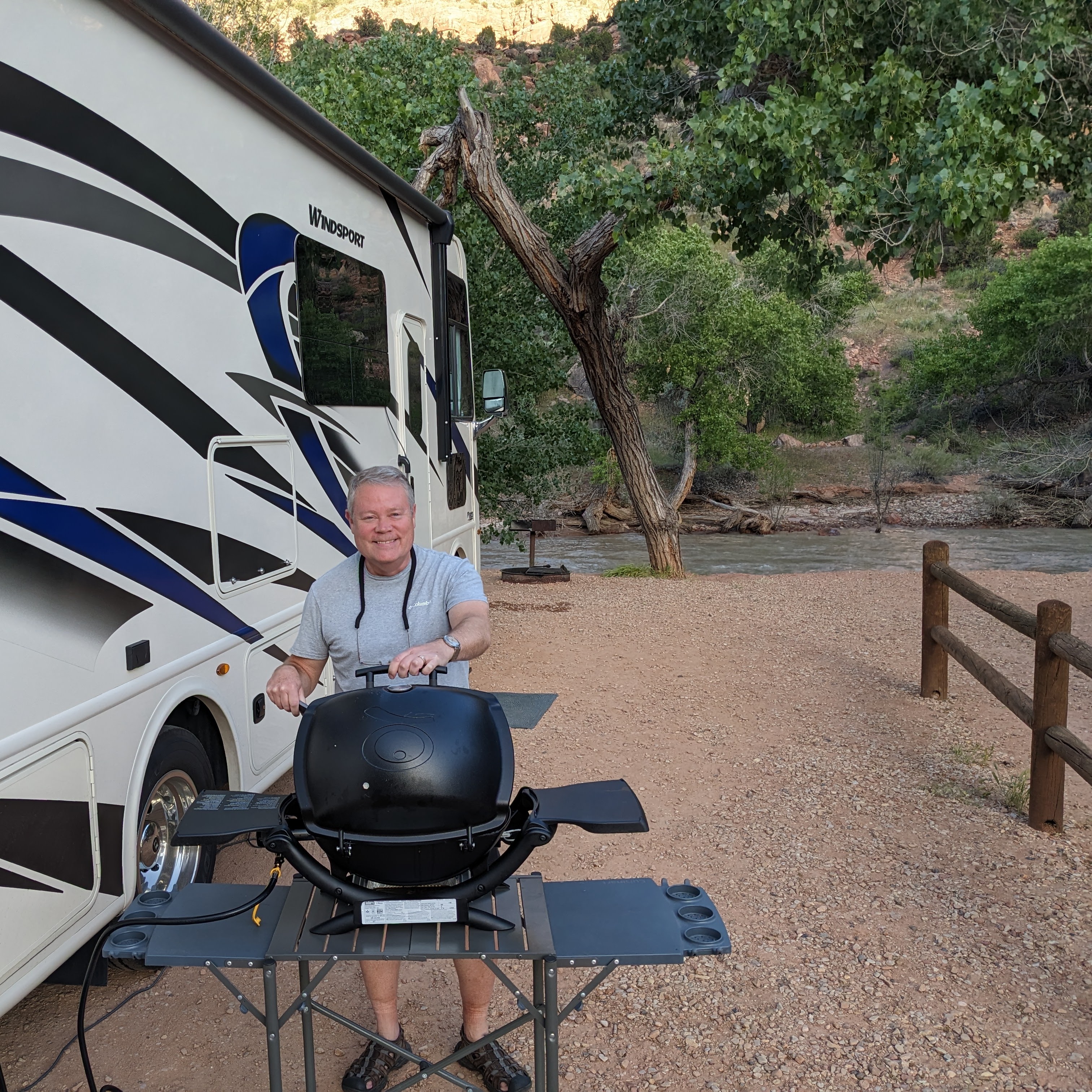
We returned to the campground and Tim bought a hiking stick at the Zion Adventures store across the street from the campground, in preparation for a more strenuous hike we planned to take the next day.  Then, we returned to our RV to grill and barbeque chicken for dinner (we had too much chicken to fit on the grill, so we also used the barbeque pit provided on our site next to the river).  We had french fries and green beans for our sides.

On our second full day at Zion Canyon, we again took the free shuttle bus from our campground to Zion National Park for more hiking.  We decided that we would do our most strenuous hike on this day, the Emerald Pools trail.  There are three separate Emerald Pools trails: the lower pool, the middle pool, and the upper pool, with the middle and upper being the most strenuous.  Along these hikes, you can see various waterfalls in the park.  The lower trail is paved but has minor drop-offs along the way.  The middle and upper trails are not paved and are considered moderately difficult hiking trails because you must climb rocks to a sandstone ledge, with moderate drop-offs along the way.  It is well worth the effort though, as the views can’t be beat!  Altogether, it is about a 2.3-mile hike and took us about 2.5 hours to complete. 
The trail started and ended at the Zion Lodge, which looks like an amazing place to stay inside the park.  Needless to say, after finishing that hike we were exhausted, and our legs were quite sore from all of the climbing up and down rocks.  So, we had drinks at the lodge (well, Tim had a beer and Pat had water) and some cookies.  Then we headed back to the campground.

On our third full day at Zion Canyon, we went back to Zion National Park for more hiking.  This time, we hiked the Riverside Walk trail located at the last stop on the park shuttle.  The trail is paved and follows the Virgin River along the bottom of a narrow canyon.  The trail has minor drop-offs and some steep slopes.  It is a 2.2-mile hike round trip and took us about 1.5 hours.  This trail accesses The Narrows trail, which actually is located within the river for most of the time.  Unfortunately, The Narrows was closed to hikers (waders) because the Virgin River had risen to dangerous heights and waterflow pressures from the melting of the record snowfall experienced at Zion National Park this winter were too dangerous for wading in the water. 
After the Riverside Walk hike, we took the park shuttle bus back to the Visitor’s Center and the Springdale shuttle bus back to our campground.  Later that evening, Tim grilled burgers for us and we had chips; a reward for three days of hiking!

Our last full day at Zion Canyon involved some maintenance and repair of the RV.  Since we full-time RV travel, it is necessary to do some routine maintenance occasionally.  We also occasionally have repairs that either we can do ourselves or require a repair person; similar to what happens when you are a homeowner.  So, we can’t always just have fun and enjoy where we are staying.  

This time, the maintenance included lubricating our slideout, steps, doors, windows, and key holes.  We used a product called Boeshield T9 for lubricating all of these areas.  Tim had heard about this product at RV Boot Camp, and there was a retailer selling the product at Escapade in Tucson, Arizona; so, we bought a can at that time.  Lubricating was pretty simple, with the toughest area being the slideout, which required climbing a step stool to reach the top portion of the slideout and retracting and extending the slideout after application.  

Repairs included fixing the sliding door at the entrance to the bathroom.  We had been having some trouble opening and closing the sliding door at the entrance to the bathroom since shortly after we purchased the RV but were able to open and close it without too much difficulty.  As we were leaving Las Vegas (again, pun intended), the door would not move correctly.  We discovered that the railing that the door slides on at the top was loose from the ceiling.  When we got to Zion Canyon, we tried fixing the issue ourselves by screwing it back into the ceiling but to no avail. 
We tried calling several repair companies in the Springdale, Utah area, where Zion Canyon is located.  We finally settled upon a repair company called Dispatch RV Mobile Service, which will travel to your campground to make necessary repairs.  The repair person, Stephen, arrived mid-afternoon; and after explaining the issue, he went right to work.  He completed the repairs in about an hour and now the door works better than when we bought the RV.

That night, our last night in Zion Canyon, we went to a restaurant across the street called Spotted Dog.  Tim had Rocky Mountain trout with wild rice and berries, and Pat had the Muscovy Duck Breast with fingerling potatoes, squash, and chickpeas. 
Then we headed back to the RV to rest up for our trip the next day to a new destination!

The next morning, as we drove to our next destination, we got to drive through an additional part of Zion National Park.  This gave us a view of the park that was new to us; with several twists and turns on the road around the canyon walls revealing more beautiful scenes (the RV handled beautifully around these tight curves and steep inclines).

Along this route, we drove through the Zion-Mount Carmel Tunnel; a 1.1-mile tunnel that was built into the canyon and opened in 1930.  It provides direct access from Zion National Park to Bryce Canyon and Grand Canyon National Parks.  The tunnel is not large enough to accommodate an RV our size in one lane and have traffic flowing from the other direction, so in order to go through the tunnel with an RV over 11’4” tall or 7’10” wide, you must purchase a permit for $15 and obtain ranger assistance at the entrance to the tunnel.   Once we reached the entrance to the tunnel, the ranger stopped the traffic from the other side of the tunnel, and we were allowed to drive through the center of the tunnel leading a line of cars behind us (and stopping a line waiting on the other end).  It was a unique experience; a little nerve-racking, but also sort of fun as we drove on to our next destination! 


It is difficult to imagine how any campground could be in a more beautiful location than Zion Canyon Campground and RV Resort in Springdale, Utah.  Located within the canyons that make up Zion National Park and adjacent to the Virgin River, this campground is unique in its beauty.  

Zion Canyon Campground and RV Resort is the only campground located in Springdale, Utah.  It has 131 RV sites and 15 tent sites; and they were constructing cabins while we were there.  Most of the RV sites have full hookups, but some of the RV sites located along the river (like our site) have electricity and water, but no sewer hookup.  Each site has a picnic table, grill/BBQ, and fire pit.

Other amenities include a playground, pool, shared pavilion with picnic tables and grills, bathroom/shower facilities, and a laundry facility.  The office also has a small store for basic food items and RV supplies.  In addition, there is the Hoodoos General Store located across the street from the campground that also has an ice cream parlor.  There is one restaurant next door to the campground and another across the street from the campground.  There is also the Zion Adventures store across the street with all of what you might need for hiking and boating.

Maybe the best thing about Zion Canyon Campground and RV Resort (next to the beauty of its surroundings) is that it is located within walking distance of the entrance to Zion National Park, but also has a shuttle bus stop located on the street outside of the entrance to the campground that will take you to Zion National Park for free.  The shuttle bus also passes other restaurants and shops along its route (that are also within walking distance if you don’t want to take the shuttle bus).  These are perks that are hard to find.  

Despite not having a sewer hookup and having to limit our water usage in the RV and take showers in the campground’s shower facility, having an RV site adjacent to the Virgin River is something we will treasure.  We couldn’t recommend Zion Canyon Campground and RV Resort any more highly.  We would stay here a hundred times if we have the opportunity to do so in the future.